Showing posts with label fresh and frugal. Show all posts

Wednesday, June 12, 2013

Fresh and Frugal: Skirt Steak with Chimichurri

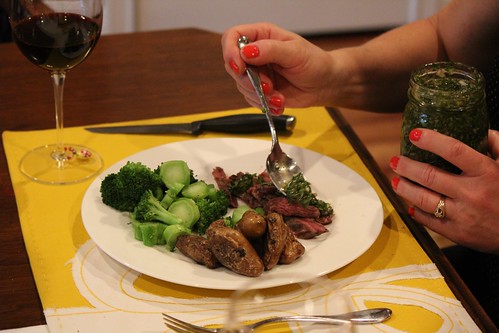
Skirt steak with chimichurri | coppertopkitchen.blogspot.com

My parents were in town last week, and I wanted to treat them to some great food! During my regular market trip, I stopped by the Mint Creek Farm stall to check out their selection and prices. I had ribeye on the brain, but at $29/pound, it was outside my price range for four people on a regular weeknight. Sustainably-raised beef is pricey. So how can a steak-lover answer a craving without bombing their budget? Two ways: choose a cheaper cut, and shrink portion sizes. Scanning the list, I decided on just under a pound of skirt steak.

What's wrong with cheap meat? First of all, meat can be bought so cheaply at your local supermarket because of how it's raised: in concentrated animal feeding operations (CAFOs). Animals are packed very tightly into these facilities, with barely any room to move, and are fed a diet of mostly grain. These conditions lead the animals to a much higher-than-normal susceptibility to disease and infection, and so farmers routinely mix antibiotics into their feed. Aside from the fact that this is a sad life for animals, these practices are also detrimental both to the environment and to the nutritional quality of the meat. For a deeper look into these issues, I highly recommend In Defense of Food and The Omnivore's Dilemma, both by Michael Pollan, and Food Matters, by Mark Bittman.

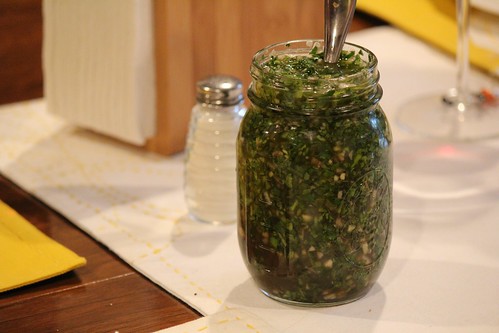
Chimichurri sauce | coppertopkitchen.blogspot.com

Tips for successfully serving smaller portions:

Don't overcook. Always important, but especially so with grass-fed meats, which are leaner and slightly tougher than their conventionally raised counterparts.

Season well. With salt and pepper, of course, but also with herbs, spices, butter, or sauces. Depending on the cut and preparation, adding something extra can really highlight the unique deliciousness of the meat.

Serve great sides, and lots of 'em. Nothing would be worse than getting to the end of your meal and worrying that your guests are still hungry!

Skirt steak with chimichurri | coppertopkitchen.blogspot.com

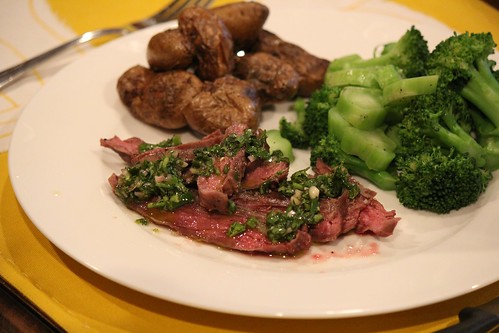
I used this recipe for chimichurri from the new Bon Appetit Grilling Book (which would be a GREAT Father's Day gift if you don't already have one!), and since we are without a grill, I arranged the steak on a rack set on a baking sheet, sprinkled it with salt and pepper, and broiled it on high for 2 minutes on each side. It was perfect.


Tuesday, May 28, 2013

Fresh and Frugal: Roast Chicken

This post is part of an ongoing series called Fresh and Frugal, in which I share practical ways to make it easy to eat well on a budget. Eating well can be thought of from a lot of different angles, from good health and nutrition, to mindfulness about the environment, to supporting local economies. We should be able to accomplish all of this without sacrificing pleasure or breaking the bank, and that is what these posts explore. _____________________________________________________________________

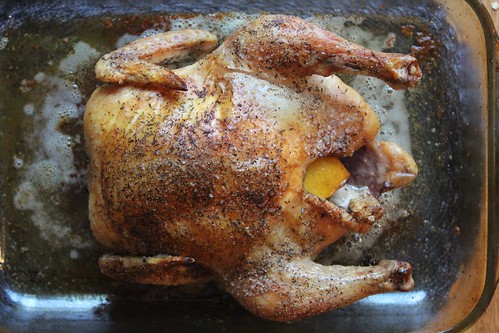
roast chicken

With the mercury rising, our thoughts turn to how to get dinner on the table without the aid of oven or stove. We don't have a grill, so I like to cook in bigger batches once a week. If I'm heating up the oven, I'll roast a chicken, bake a bunch of potatoes, and roast some veggies. These simple staples can be reinterpreted for a week's worth of interesting and delicious meals.

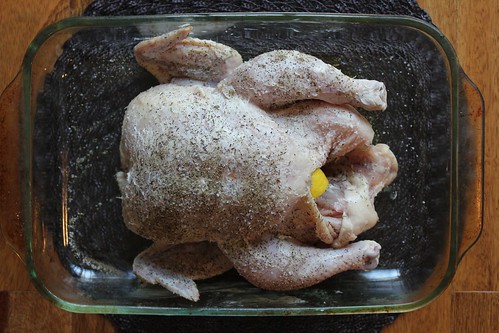
Chicken | coppertopkitchen.blogspot.com
Roast chicken | coppertopkitchen.blogspot.com

I use a very simple method for roasting. I season the inside of the chicken with salt and pepper, and stuff with a quartered onion, a quartered lemon, and a few smashed garlic cloves, then rub the outside with about a tablespoon of softened butter and season it well with salt and pepper. I roast it in a 425 degree oven for a relatively short time (depends on the size of the chicken, but I use this as a guideline); the high heat ensures a crispy, golden skin and tender meat. There are plenty of variations, but I find this simple way to be the most conducive to reinterpretation.

Simple chicken dinner | coppertopkitchen.blogspot.com

Dinner #1: juicy chicken, baked potato, and whatever vegetable is in season.

When the chicken is cooled, I remove all the meat and store it in a container in the fridge. I then put the carcass, stuffing and all, in the crock pot with a bay leaf and a handful of rough chopped vegetables (carrots, celery, onion, parsnip, whatever's in the crisper), cover with cold water, and set on high overnight. Strain the stock in the morning, cool, and freeze for another use. The last time I made stock, I had a quart plus an ice cube tray (which I will use one at a time to add to baby food or in recipes that call for a splash of stock).

Dinner #2: Roast chicken sandwiches: toast two slices of bread, and spread one with mayonnaise. Layer some chicken on the mayo, and top with a crunchy piece of lettuce. Season with salt and pepper and top with the other slice of bread.

Dinner #3: Use chicken as a pizza topping!

Dinner #4: Chicken tacos or quesadillas.

Dinner #5: Toss chicken and roasted vegetables with cooked pasta.

Dinner #6: Big salad topped with chicken.

Obviously the number of meals you get from a single chicken will depend on the size of the chicken and the size of your family, but you can see that it's not hard to stretch your food dollar when you start out this way. And at $2.69/pound at Trader Joe's (as opposed to double that for boneless, skinless breasts), buying sustainable meat becomes a real viable option, no matter your budget.

Tuesday, February 19, 2013

Fresh And Frugal: Homemade Lamb Stock + Tan Abour

This post is part of an ongoing series called Fresh and Frugal, in which I share practical ways to make it easy to eat well on a budget. Eating well can be thought of from a lot of different angles, from good health and nutrition, to mindfulness about the environment, to supporting local economies. We should be able to accomplish all of this without sacrificing pleasure or breaking the bank, and that is what these posts explore.
Fresh and Frugal: Lamb Stock

I think most people know that it's possible (and preferable) to make chicken or beef stock at home, using leftover bones that would otherwise be thrown away. It's so easy, and if you consider that you were going to throw away the ingredients anyway, you're basically making money on the proposition. But what to do if your recipe calls for lamb stock, your husband isn't terribly fond of lamb, and you don't feel like shelling out $20/pound on lamb when you'll have to eat it all yourself, and all you really wanted was soup?

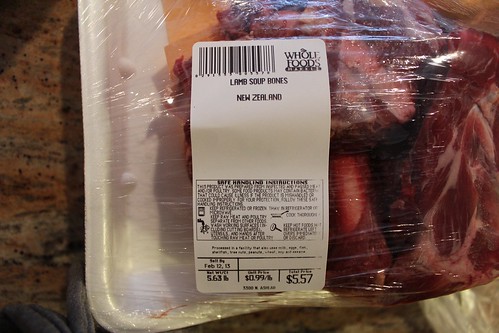
Here's what I did: I went to the meat counter at Whole Foods, and asked if they happened to have lamb soup bones. I could tell the guy had never gotten this request before; he told me they have beef bones for sale (good to know!), but no lamb. I pushed him further, wondering if he might have a lead for me (I reallllly wanted to make this soup), and he said, "Well, we get lamb carcasses in on Fridays and break them down; if you want to come in on Saturday, we could set the leftover bones aside for you."

You know you are getting serious in the kitchen when people start throwing around the word "carcass."
image

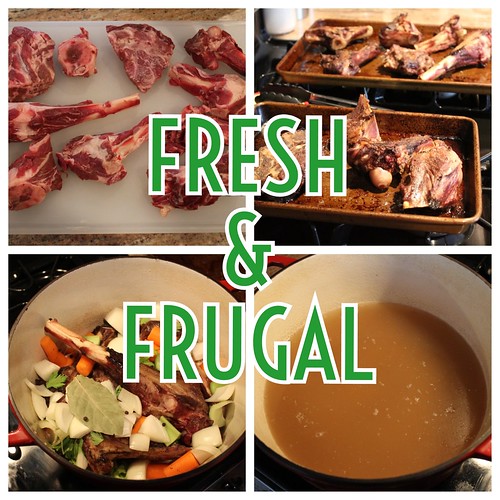
Saturday rolls around, and I am just about giddy with excitement. Five and a half pounds of fresh, amazing lamb bones for... 99 cents a pound! I felt a little like I had won the lottery, and got down to business. I rubbed the bones with olive oil, seasoned them with salt and pepper, and roasted them at 350 degrees for about 45 minutes, until they were popping and crackling, and looked a little crispy. Then I divided them into two big pots, added onions, carrots, celery, bay leaves, and cold water, and simmered them all day long. After straining out all the solids, I had SIX QUARTS of stock! Less than 99 cents a quart, and that's not even counting the approximately 2 cups of leftover meat that I got off of the bones!

In a nutshell, boiling bones extracts all the good stuff from them: vitamins and minerals, gelatin, and tons of flavor. The resulting stock is a healing, nourishing food, and a cooking staple, wonderful for drinking plain, making soups, or enhancing flavor in rice or sauces. Read all about the nutritional benefits of homemade bone broth here.
image

Remember how excited you got in college when someone offered you free food? This is like that on steroids.
image

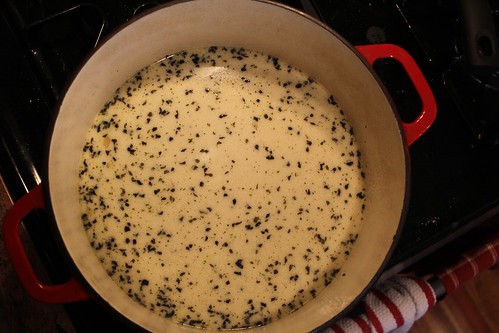
It's funny; I served this soup to a friend for lunch the other day, and she commented that she liked the unusual tangy flavor (from the yogurt, of course). It occurred to me that I had never thought to think about what this soup tastes like, specifically. Like other things my mom made a lot while I was growing up, this soup tastes like home.

Tan Abour

2 quarts lamb stock
1/2 cup barley
3 cups madzoon (plain yogurt, full- or low-fat)
1 egg
4 tablespoons (1/2 stick) butter
1/2 cup chopped onion
1 teaspoon dried mint
1 teaspoon dried parsley
salt and pepper

In a large pot, heat the lamb stock with the barley. Cook until the barley is tender, seasoning the stock to taste; about a tablespoon of table salt, and 1/2 teaspoon black pepper. In a small bowl, beat the egg and madzoon (yogurt) together. Slowly whisk in about a cup of the hot lamb stock to temper the mixture, and then add it slowly back to the pot. In a small skillet, melt the butter, and saute the onion over medium-low heat until translucent, about 5-7 minutes. Stir in the mint and parsley, and then stir the onions into the soup. Serve hot.

Simple Lamb Stock

Yield: 6 quarts

5 pounds lamb soup bones
2 onions
6 carrots
4 ribs celery, with leaves
1 tablespoon whole black peppercorns
2 bay leaves

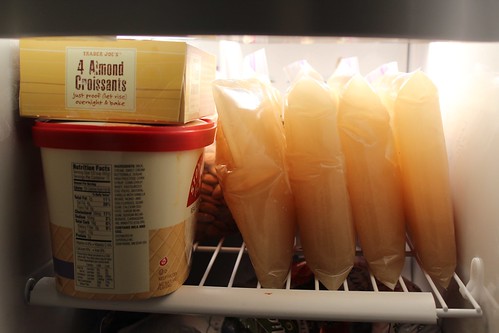
Combine all ingredients in one giant stock pot (or two soup/pasta pots), and cover with cold water. I've heard that adding a tablespoon or two of vinegar aids in extracting the nutrients from the bones; I intend to try that next time (always learning!). Bring the water to a boil, cover the pot, reduce the heat to low and simmer for as long as you like; at least 6-8 hours, preferably 12-24. You can also do this is a slow-cooker. Strain out the bones and veggies, chill the stock, and use it in the recipe above or freeze it. Storage tip: if you lay the freezer bags flat in the freezer, they take up much less space, and are easily organized.

Wednesday, September 5, 2012

New Series: Fresh and Frugal!

fresh and frugal

It's back to school time! We can all stand to learn a little something new, and this fall I would like to introduce a new series in the Coppertop Kitchen called Fresh and Frugal. The purpose of these posts is to share practical ways to make it easy to eat well on a budget. Eating well can be thought of from a lot of different angles, from good health and nutrition, to mindfulness about the environment, to supporting local economies. We should be able to accomplish all of this without sacrificing pleasure or breaking the bank, and that is what these posts will aim to explore. Let me know if there's a specific food or topic you'd like me to talk about!

You may have heard a story in the news over the past couple of days regarding a study that was published in the Annals of Internal Medicine, regarding the nutritional differences between organic and conventional produce. Headlines in many major news outlets said things like, "Why Organic Food May Not Be Healthier For You," (NPR) and "Organic Food Adds No Vitamins For Extra Cost" (Bloomberg Business Week). These headlines made me laugh a little to myself, and when I read the articles I was surprised that anyone would be duped into thinking they contained anything that might be thought of as "news." Most conscious consumers of organic food would tell you they were never under the impression that there were more vitamins in something just because it bears the "organic" label. And mostly, that's not the point. Organic farming practices are vastly better for the environment, using methods of fertilization and pest control that actually improve the quality of the soil, rather than dumping chemicals which run off into water sources and kill beneficial insects and bacteria. There's also the matter of pesticide residue, the effects of which we still don't know (and I'm sorry, but a two-year study is not quite long enough to convince me).

For me, "organic" is not the most important descriptor of good food. For one thing, organic certification is expensive, and many small farms that employ organic farming practices simply can't afford it. "Local" is much more important to me. I like being able to support my local economy by buying peaches from the same farmer week after week. It makes me feel connected. And get this! The produce I buy at my local farmers' market is probably more nutritious because it was more likely to have been picked when ripe, and didn't have to travel for days over thousands of miles to get to me. Something that was living on a tree yesterday and is in my belly today gives me more vitamins than something that was living on a tree a week ago, and was picked before it was ripe so that it could more easily be shipped without damage.

Other adjectives that get me excited:
  • Free-Range: Meat and eggs from free-range chickens are higher in beta carotene, protein, and hello, flavor. Be careful about this label, though, and buy from a producer you know if you can. Free-range technically means that the birds have access to the outdoors, not necessarily that they go out there and get exercise and peck in the grass.
  • Grass-Fed: Beef from cows that grazed on grass for all of most of their lives is leaner, higher in omega-3 fatty acids, and less likely to have been serially treated with antibiotics. It tastes different, and because it's leaner it cooks differently, but it is delicious. Dairy from pastured cows is better, too! Healthier cows produce healthier foods for us, and since cows aren't naturally adapted to eat grain (which is fed to them because it's cheaper), it makes them sick, which makes them need antibiotics. Sad cows. This is another example, though, of where the "organic" label can lead you astray. Organic milk likely just comes from cows that were fed organic grain, not allowed to graze on pasture. Read the labels!
  • Wild, Line-Caught, Pole-Caught: There's fishing and then there's fishing. Farmed salmon is fed (you guessed it) grain. Because its diet is less varied and nutritious, the meat from it is less nutritious. (For more about that, read this post.) Pole- or line-caught refers to the method of catching fish; catching fish with nets is much less sustainable, and causes all kinds of problems. The Monterey Bay Aquarium publishes handy pocket guides to help you choose sustainable seafood.
Adjectives I couldn't care less about:
  • All-Natural: Oh, this one is a doozy. All this means is that nothing in it is blatantly artificial. It is not an FDA-regulated label, so pretty much anyone can put it on pretty much anything. 
  • Low-fat, Non-fat, Fat-free: Get with the program, people. Fat is good for you. Your body needs it. Stop buying into the outdated idea that fat causes Type 2 diabetes, obesity, heart disease, etc. The low-fat craze did absolutely nothing to curb the spread of these lifestyle diseases. Plus, whoever said that fat = flavor was right on the money.
The bottom line is that there are a lot of factors that go into each food decision we make. I try to do the best I can while considering budget, sustainability, and nutrition, and I try to be sensible. Above all, I don't beat myself up if once in a while I buy conventionally-grown strawberries or a double cheeseburger at Mickey D's. It's all about balance and moderation.